
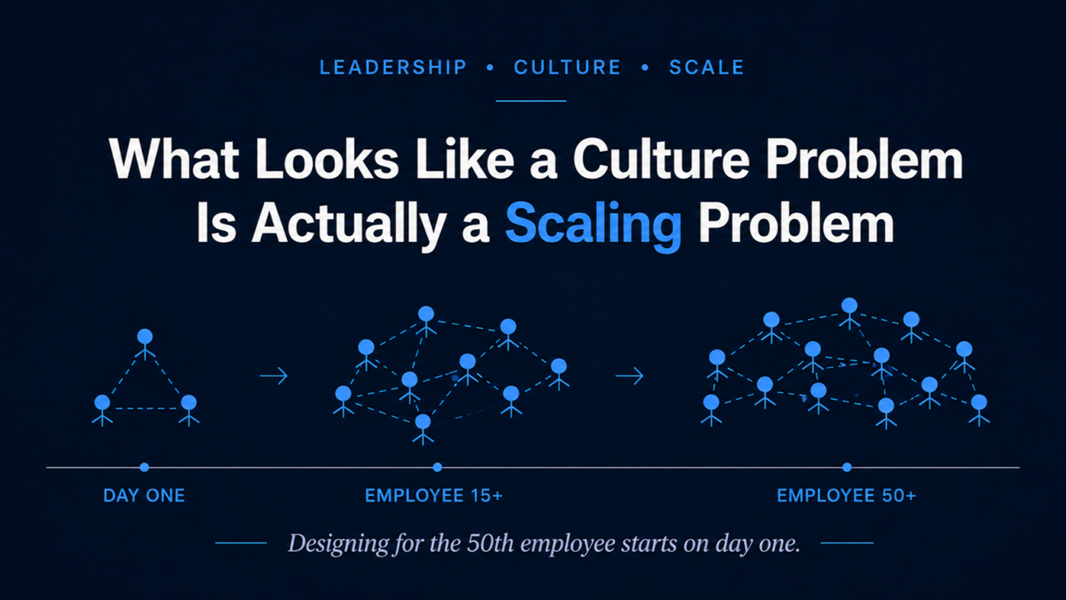
Most startups don’t lose culture suddenly. They lose it quietly—somewhere between the 15th and 25th employee.
In the early days, culture feels effortless. Alignment is natural, decisions are fast, and everyone is close to the problem, the customer, and each other. You don’t need to explain how things work because people can see it, feel it, and adjust in real time.
There’s a shared sense of purpose, drive, energy, and understanding that doesn’t need to be articulated. For a while, that’s enough.
This is also where many founders make a quiet assumption that a purpose-driven culture will continue to take care of itself. It usually doesn’t.
What works with ten or fifteen people doesn’t scale by default. It works because of proximity and shared context. As the organization grows, that disappears.
This is where things start to shift. Scaling without clarity leads to chaos. And clarity is the first thing you lose as complexity increases.
Many startup failures are ultimately tied to people-related challenges: team conflict, misalignment, miscommunication, leadership friction, and breakdown in execution.
It doesn’t show up as a “culture problem” at first. It shows up in delays, rework, tension in meetings, and a general sense that things are getting harder than they should be. People are working hard. But not always in the same direction. There’s a lot of activity, but little progress.
What looks like a culture problem is rarely just about culture. It’s usually a scaling problem.
These patterns tend to emerge at a very specific point—when shared context begins to break, and nothing has been put in place to replace it. Complexity is increasing, but clarity is still being assumed.
That's why designing culture from day 1 with the 50th employee in mind is important. This isn't about numbers but about proactively designing for the moment when shared context is gone, when founders aren’t in every conversation, and when teams start operating more independently. When “how things work” is no longer obvious.
If culture relied on proximity, it would break here. If it’s built into how the organization runs, it holds.
Most startups don’t design for this moment. They grow into it a lot faster than they realize. And by the time something feels off, culture has already started to drift.
In high-paced startups, you’re constantly balancing conflicting priorities- speed with quality, innovation with expectations, growth with risk. These tensions show up in everyday decisions, and under that kind of pressure, culture is shaped less by what’s written and more by what people consistently do.
This is where the human dynamics start to show up. Power starts to concentrate. Egos get tied to outcomes. What starts as ownership can become territorial. Leaders interpret the same values differently, one pushing for speed, another for control. Both think they’re doing the right thing, and they are, they’re just not aligned. Politics creeps in, teams start forming their own ways of working, and slowly, the organization stops feeling like one system.
None of this is unusual. But if it’s not addressed early, it compounds. Small inconsistencies turn into patterns. Patterns turn into norms.
This is where most startups get it wrong. They try to fix the culture after the cracks appear. But the issue is rarely that culture is broken. The pressure to deliver simply starts to outweigh how delivery happens. Culture was never intentionally designed to scale at the same pace as the business. So what looks like a culture problem is often a scaling problem
Culture is the sum of all behaviours, the outcome of how decisions are made, how accountability is defined, and what gets reinforced over time.
What looks like a people or culture problem is often a clarity problem that was never addressed early. The organizations that navigate this well don’t wait for cracks to show up. They define a few things critical to success explicitly, and earlier than feels necessary.
- They are clear on how decisions get made, who decides, who contributes, and how trade-offs are handled.
- They define and review roles and responsibilities explicitly based on evolving business priorities, so ownership doesn’t get blurred.
- They are deliberate about hiring not just for capability, but for how people think and operate under pressure.
- They are consistent about what gets rewarded, what gets challenged, and what gets tolerated.
- They develop evolving policies, procedures, and governance frameworks that reduce friction and ambiguity and support growth.
- They prioritize leadership alignment and behaviour above all else.
Most of this is taken for granted in the early days, and that’s where most of the future friction comes from.
Sustaining culture at scale requires a shift from implicit alignment to deliberate design. This is not about adding bureaucracy early. It’s about removing ambiguity early.
People don’t follow values in isolation; they follow the systems that shape them. How roles are defined shapes accountability. How decisions are made shapes integrity, speed, and alignment. How people are evaluated and rewarded shapes performance, behavior, and trust.
At the same time, systems don’t replace leadership. They amplify it. If leadership is aligned, systems create clarity. If leadership is not, systems make that misalignment more visible and harder to ignore.
Culture doesn’t break in a single moment. It drifts through small inconsistencies, unaligned decisions, and what gets tolerated under pressure. It’s a long-term investment. But the cost of ignoring it shows up immediately.
That’s why designing a sustainable culture requires the same level of clarity, intent, investment, and foresight as strategy, technology, product, or customer experience.
Culture is not separate from these; it is the mechanism that shapes the behaviors through which strategy is executed and outcomes are delivered.
A simple framework that allows startups to remain agile while still intentionally building culture to scale as the operations grow is AERS:
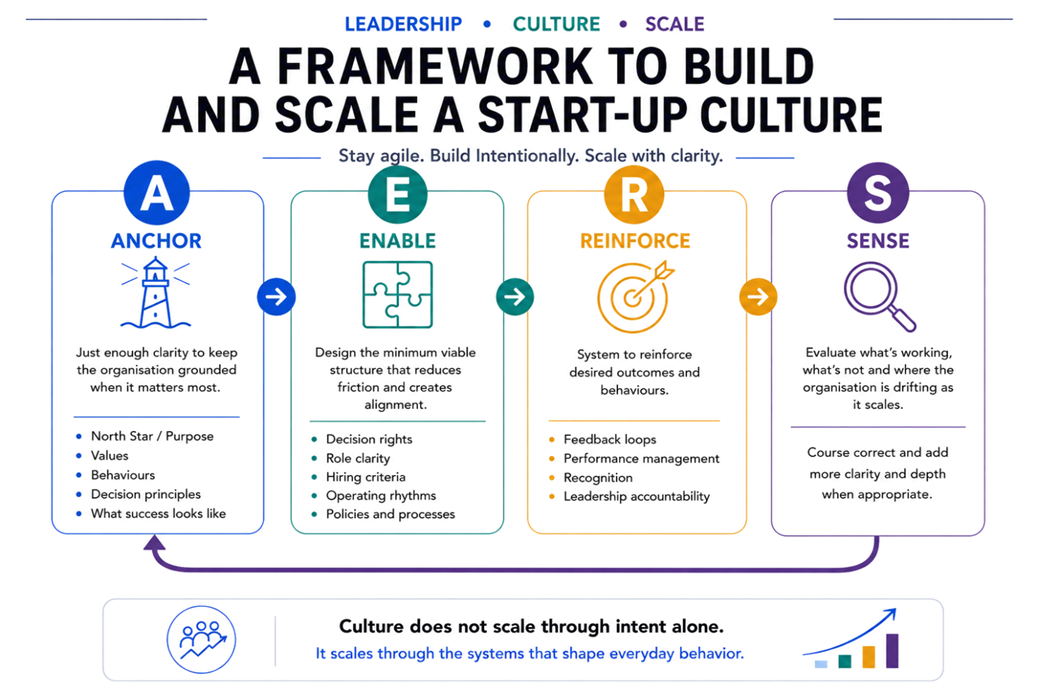
The framework outlines four core stages — Anchor, Enable, Reinforce, and Sense. It emphasizes investing early in identifying and defining the anchors that will drive success, the systems and processes required to embed it, the communication needed to reinforce it consistently, and the ability to adapt them through incremental improvements as operations evolve and scale.
It is not a linear process, but a continuous cycle that evolves alongside the organization. The key question throughout is: What will this look like for the 50th employee? Because the practices, behaviors, and decisions embedded early often become the foundation upon which culture ultimately scales.
I have seen environments that struggled most, were the ones where too much was left unsaid for too long.
Which is why designing for the 50th employee starts from day one, it's about building the scaffolding to scale—not by building everything upfront, but by being deliberate about the few things that will shape how the organization runs as it grows.
The cost of leaving culture to drift will ultimately be felt in the speed at which the organization can scale sustainably.